The applause moved. The alliances did not.
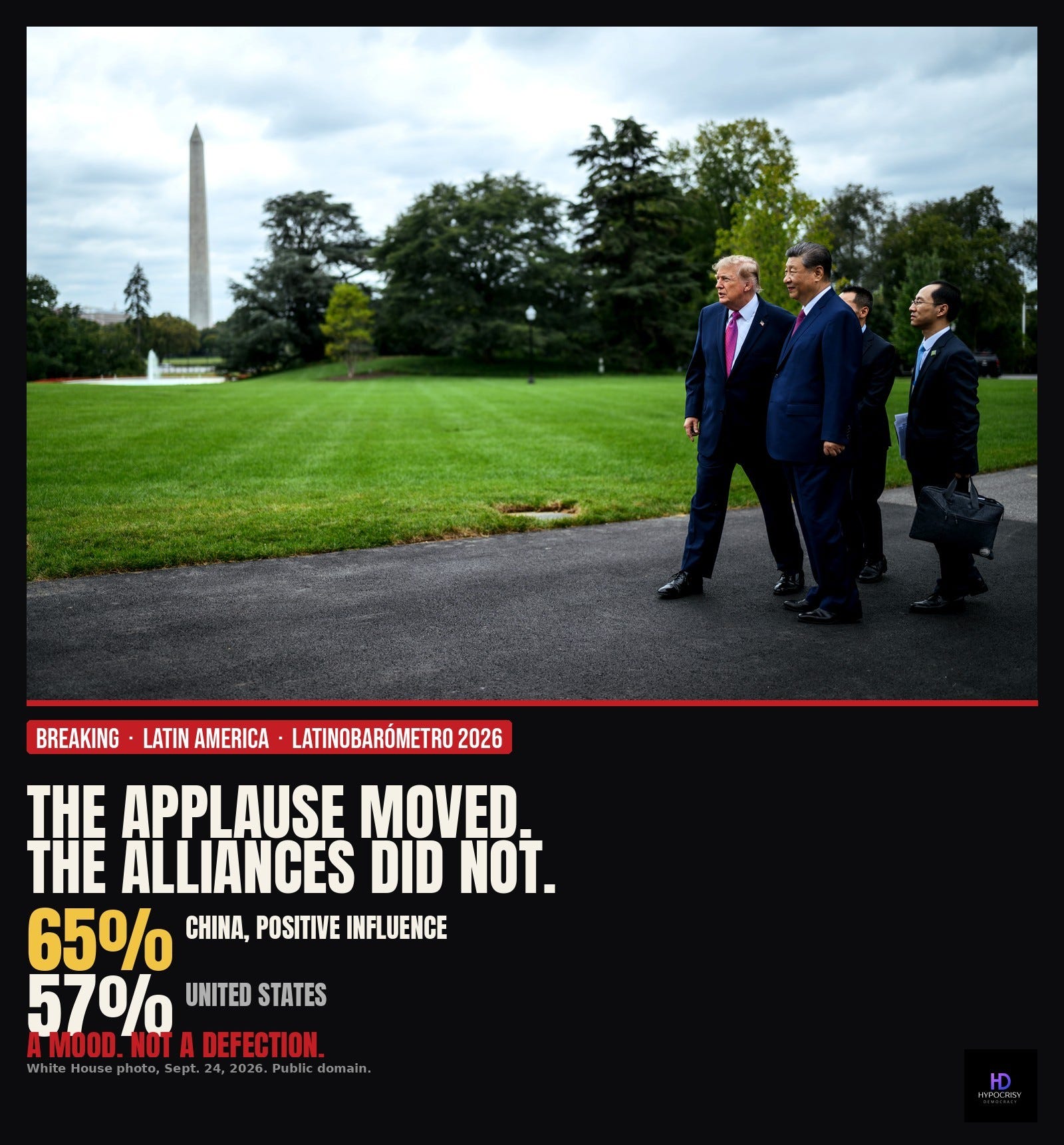
The applause moved. The alliances did not.
Latin America just rated China’s influence kinder than America’s. That is a mood, not a defection, and both superpowers are lying about the strings.
You saw the chairs. Two men, gilt furniture, a caption that starts doing your thinking for you: China’s influence in Latin America is now viewed more positively than that of the United States. AFP, via France 24, datelined Bogotá, issued October 2, 2026. The Yahoo card you were handed stamped it Fri, October 2, 2026, 5:19 p.m. EDT.
The photo is a seating chart. The poll is a mood. Neither one is a treaty.
What 19,207 people were actually asked
The survey is Latinobarómetro 2026, directed by Marta Lagos. It is not a world poll. It is 17 Latin American countries, and only those. Nicaragua was left out, the report says, for security. Fieldwork was face to face, people 18 and older, May 7 through June 17, 2026. South America and Mexico got about 1,200 interviews each. Central America and the Dominican Republic got about 1,000. Total: 19,207. Margin of error about 1 point for the region, about 3 points inside any one country.
The influence item, printed on the charts, is not a vibe and not a vote. For the United States: “Tomando todo en cuenta, ¿diría Ud. que la influencia de EEUU es más bien positiva, o más bien negativa?” For China, the parallel line: “Tomando todo en cuenta, ¿Y la influencia de CHINA es más bien positiva, o más bien negativa?” Taking everything into account, is the influence mostly positive, or mostly negative?
Regionwide, in 2026, **65 percent called China’s influence positive. 57 percent said that about the United States.** In 2020 those numbers were 48 and 60. China’s negative reading fell from 37 percent to 26. America’s rose from 28 percent to 37. The report’s own sentence: “Estos datos dan para concluir que China tiene más influencia en América Latina que EEUU.”
Read the next sentence before you tattoo that on a mug. **The same report still has the United States ahead on plain favorability: 63 percent favorable, China 59, the European Union 58.** Good relations, a different question, also still tilt to Washington: 71 percent, then China 67, then the EU 59. AFP’s writeup said 58 percent favorable toward China and 73 percent favorable toward the United States in 2024. The report text says 59 percent for China now, and 72 percent favorable toward the United States in 2024, falling to 63. When the wire and the PDF disagree by a point, **keep the PDF.**
The countries, all 17: Argentina, Bolivia, Brazil, Chile, Colombia, Costa Rica, the Dominican Republic, Ecuador, El Salvador, Guatemala, Honduras, Mexico, Panama, Paraguay, Peru, Uruguay, Venezuela.
Costa Rica and the Dominican Republic are the cases the prose flags as still rating U.S. influence more positive than China’s. The chart says Costa Rica is 74 percent positive on the United States and 73 on China. The Dominican Republic is 79 and 70. Honduras, which the prose does not mention, is 57 and 56, United States ahead by one. **A one-point “win” sits inside the report’s own ±3-point country margin. Call it a tie in a costume.** Chile is not a costume: 70 percent positive on China, 46 on the United States. Mexico is 65 and 33. Peru, where the report itself points at the port, is 72 and 62. Venezuela runs the other way: 76 percent positive on U.S. influence, 53 on China’s.
El País has Lagos saying the region learned to get by, and that Europe and Japan filled space too, not only Beijing. The report’s line is that Washington had been “casi ausente” since the Iraq war. AFP rendered that as an “almost complete absence.” Absence is the story Lagos is selling. It is not the trade table.
A mood is not a marriage
No government in this poll renounced a treaty, quit the OAS, or “chose China” the way a headline wants you to hear it.
The report’s own footnote lists twelve governments inside what Washington calls the Escudo de las Américas, the Shield of the Americas: Argentina, Bolivia, Chile, Colombia, Costa Rica, the Dominican Republic, Ecuador, El Salvador, Honduras, Panama, Paraguay, Peru. In several of those countries the public still rates China’s influence more positive than America’s. Chile’s government can stand next to the White House and Chile’s respondents can still hand Beijing a 24-point lead on this one question. The report says the quiet part: the color of the government is not the same thing as the perceived influence.
That is the elite habit. Take the security handshake in Washington. Take the commodity check in Beijing. Tell the voters you did it for them.
On Donald Trump himself, the same survey is colder than it is about the country. Second-term rating: 4.7 on a 0-to-10 scale. Disapproval of how he handles international affairs: 59 percent, against 34 percent approval. Asked how his policies will hit the world, 55 percent say negative, 38 percent positive. Mexico is the hard edge, a 2.8 rating and 79 percent disapproval. Venezuela is the soft edge, 61 percent approval of his international conduct.
They can clap for a raid and still shrug at the sequel. The report says Argentina is the only country without a majority in favor of Nicolás Maduro’s capture, at 47 percent. On whether the capture benefits Venezuela, there is no majority at all: 35 percent say it benefits the country, 29 percent say it harms it, 28 percent do not say. AFP flipped the harm figure to 28. Again, the PDF. Only Costa Rica (58) and the Dominican Republic (54) have a majority saying Venezuela benefited. The Cuba embargo is a separate scolding: 50 percent disapprove, 34 percent approve.
The void in the pocket
Lagos told AFP the line you should keep: “The void that China fills is the void in people’s pockets, more than anything else.”
Cheaper imports are not a conspiracy theory. They are a receipt. The Boston University Global Development Policy Center’s 2025 China–LAC bulletin, by Rebecca Ray and Enrique Dussel Peters, calculates from IMF and UN Comtrade data that in 2024 Latin America and the Caribbean exported an estimated $190.9 billion in goods to China and bought an estimated $286.7 billion back. **Deficit: about $95.8 billion, a record 1.4 percent of regional GDP.** China was 13 percent of the region’s exports and 22 percent of its imports. Chinese goods were 28 percent of the region’s manufactured imports. Telecommunications equipment alone was 11 percent of what the region bought from China in 2020–2024.
The same bulletin says the region now accounts for about two-thirds of global soybean exports and nearly half of global beef exports, with China buying the majority of both, and that LAC–China shipments make up nearly two-thirds of global soybean trade, nearly half of global supply in beef and in copper ores and concentrates, and about a fourth of iron ore. Copper ores and concentrates were nearly a fourth of everything the region sold to China in 2024. Refined copper slipped. Frozen beef moved up. **You are not watching a development romance. You are watching a bulk-commodity marriage with a consumer-electronics side piece.**
Peru’s exhibit is concrete. ANDINA, Peru’s state news agency, reported the November 14, 2024 opening of the Chancay terminal, about 80 kilometers north of Lima, built by COSCO Shipping with a $1.3 billion investment, and said it would cut maritime travel time to China by 12 days. China’s foreign ministry, writing up Xi Jinping and Dina Boluarte ordering “Open the port!” by video from Lima, said one-way shipping time would fall to 23 days, logistics costs by more than 20 percent, and direct jobs by more than 8,000 a year. Latinobarómetro then did the obvious thing and tied Peru’s China lead on the influence question to that port. **A port is not a ballot. It does change what “influence” feels like at a checkout counter.**
The 2024 project list in the Boston University bulletin is the rest of the hardware: a $3.5 billion Las Bambas copper expansion pursued by China Minmetals in Peru; $3.5 billion in electricity distribution pursued by State Grid in Brazil; $1.4 billion in lithium pursued by CATL in Bolivia and $857 million more by Qinghai CITIC Guoan, also in Bolivia; $979 million in offshore concessions for CNOOC in Brazil. On the contract side, not ownership, the bulletin logs a $5 billion China Railway Design contract for a Panama–Chiriquí railway, a $2.8 billion China Railway Tunnel contract for Panama Metro Line 3, a $2.5 billion contract for sections of Santiago Metro Line 7, and a $3.6 billion State Grid Brazil transmission contract. Those are entries in a monitor, not ribbons you cut. Treat them as claimed deals, not as finished miracles.
Colombia signed the paper. On May 14, 2025, Xi and Gustavo Petro watched their governments sign a Belt and Road cooperation plan in Beijing, and the Chinese government’s English readout called it formal accession. Xi said China was willing to import more Colombian goods and to put Chinese firms into Colombian infrastructure, wind power, and electric vehicles. That is a government choice. It is still not a defection from the United States. It is a second signature on a second check.
Washington still rings the register
Here is the part the Yahoo card skips, and it is the part that makes the chest-thumping look cheap.
ECLAC’s 2025 trade outlook, and the press release that launched it, still call the United States the region’s main trading partner. Goods trade between the region and the United States was $1.07 trillion in 2024. The U.S. share of the region’s goods exports fell from 56 percent in 2000 to 44 percent in 2024. Its share of the region’s imports fell from 46 percent to 28 percent. Fallen is not gone. **Mexico still sent 81 percent of its goods exports to the United States in 2024.** The Dominican Republic, 59 percent. Brazil, 12. Argentina, 8. Paraguay, 4. Bolivia, 3. Strip Mexico out and the U.S. share of the rest of the region’s goods exports drops to 17 percent.
So Mexico is lashed to the American factory floor and, in this poll, the least impressed by American influence: 33 percent positive, 62 percent negative, the worst pair in the set, while China’s influence gets a 65. **That is not “Mexico chose China.” That is a public that lives inside a U.S. supply chain and still does not like the way the influence feels.**
The tariff map is why the feeling has a date stamp. ECLAC says the United States’ average effective tariff rose from 2.4 percent in 2024 to 17.4 percent by September 2025, the highest since 1935. Latin American and Caribbean exporters face a lower average, about 10 percent, seven points under the global average Washington is applying. The ugly end of that average is Brazil at 33 percent, Uruguay at 20, Nicaragua at 18. Mexico’s average effective rate is 8 percent, because most of its exports still enter free under USMCA or an exemption. Lower-than-Asia is not the same thing as partnership. It is a leash with a number on it.
ECLAC also says announced FDI projects in the region in the first half of 2025 totaled $31.374 billion, down 53 percent from a year earlier and 37 percent below the 2015–2024 average. And then the UN commission tells the region’s governments to diversify toward China, the European Union, India, ASEAN, the Gulf, and Africa. **Washington lectured the hemisphere about loyalty in the same year its own trade shock pushed the UN’s economists to recommend Beijing as a hedge.**
The doctrine got a nickname, and the nickname is sloppier than the memes. On December 2, 2025, the White House issued a “Trump Corollary” to the Monroe Doctrine and claimed, “We restored U.S. privileged access through the Panama Canal.” That is a boast in a proclamation, not an audit. On January 3, 2026, after the Caracas raid, a transcript of Trump’s remarks has him saying the Monroe Doctrine “is a big deal, but we’ve superseded it by a lot,” and then: “They now call it the ‘Donroe’ Document.” He also said, “American dominance in the Western hemisphere will never be questioned again,” and “We’re going to run the country” until a transition he likes. The embed, if you put one in, is the full January 3 press conference: RSBN’s YouTube recording. Embed that player. Do not pretend a clip is a footnote.
You do not get to call a region your backyard, announce you will run one of its countries, hang a 33 percent tariff on its largest economy, and then act shocked that “positive influence” slipped.
Aid got the same treatment, earlier. AP reported the administration pulling almost all USAID workers off the job under a freeze Trump ordered. The 2024 money AP tallied is not trivia: nearly $385 million disbursed to Colombia, including some $45 million to the World Food Programme, largely for Venezuelans who had fled; $22.6 million to Brazil; some $135 million to Peru. Petro’s response, also in that piece, was that some of the help was “poison” because Washington had been paying Colombian border officers. **Even the cutoff arrived pre-loaded with hypocrisy on both ends: a donor canceling the work, and a recipient happy to insult the check he had been cashing.**
Beijing’s no-strings sale
Beijing’s pitch is that it does not lecture. The strings are just denominated in ore, ports, and silence.
New Chinese policy-bank lending to the region is not the 2010s firehose. The Boston University bulletin says overseas development finance from China Development Bank and China Exim rose from $1.3 billion in 2023 to $2.8 billion in 2024, the highest in five years and still far below the decade when those loans sat alongside, or above, the World Bank and the Inter-American Development Bank. Since 2020 almost all of it has gone to financial intermediaries, especially Brazilian public banks, not to named projects. **Net public and publicly guaranteed transfers from China to the region have been negative since 2019.** The region has been paying China back more than China has been disbursing. That is the opposite of a gift.
The debt scare also gets inflated by people who need a villain. In the World Bank data the bulletin uses for 2023, no included country owed more to Chinese official creditors than to other creditor classes. Suriname was the outlier on stock, with PPG debt to China at 14.1 percent of GDP, and even Suriname owed more to multilaterals, the IMF, and bondholders. The caveat is the whole game: Venezuela, a major Chinese borrower in Boston University’s own finance database, does not show up in those World Bank debt tables. **If the books hide the biggest client, “no strings” and “no debt crisis” are both advertisements.**
The commodity mix is the environmental string nobody puts in the toast. The bulletin’s top exports to China are unprocessed. It also notes why Brazil and China bothered to announce “Soja China” traceability and why COFCO nodded at the Amazon soy moratorium: beef and soy for the Chinese market are already politically tied to deforestation. **You do not launch a deforestation-free soybean brand unless the ordinary soybean brand has a problem.**
Mexico, meanwhile, spent 2025 talking about tariffs of up to 50 percent on imports from countries without a free-trade agreement. The bulletin says that would land mostly on China: 81 percent of Mexico’s non-FTA imports in 2024, $131 billion out of $160.4 billion. Brazil opened an anti-dumping case on hot-rolled steel that, on the bulletin’s account of the official circular, is aimed at a flow coming overwhelmingly from China. Publics can call the influence positive and governments can still reach for a tariff. **Both things are true, which is why the headline is too small.**
The shove, when it comes
Panama did not send a mood. It sent a court. AP reported that Panama’s Supreme Court ruled the CK Hutchison subsidiary’s concession at the canal ports unconstitutional, with the story anchored to a January 30, 2026 scene of Balboa still working. President José Raúl Mulino said the ports would keep operating and that a Maersk subsidiary would run them in a transition. The comptroller’s audit, which the company denied, claimed irregularities had cost the state about $300 million since the 2021 extension and an estimated $1.2 billion over the original contract. CK Hutchison’s earlier sale toward a BlackRock-linked consortium had already stalled, AP reported, after Beijing objected. Hong Kong’s government told its firms to look hard at Panama. China’s foreign ministry said it would defend “the Chinese company.”
**Count the hypocrites. Washington treated a Hong Kong concession as if it were a Chinese naval base. Beijing treated a court ruling as an injury to China. Panama’s own governments had extended the deal and then declared it broken.** The canal did not change oceans. The story did.
Italy is the non-Latin American case, and it cuts against the cartoon, not with it. In December 2023 Reuters reported that Rome had told Beijing it would not renew the Belt and Road memorandum signed in 2019, the first by a major Western economy. Giorgia Meloni’s line: the tool “has not produced the results that were expected.” Italian exports to China had gone from 13 billion euros in 2019 to 16.4 billion. Chinese exports to Italy had gone from 31.7 billion to 57.5 billion. **The flagship Western member looked at the trade gap and walked. Latin American governments looking at a different gap, commodities out and manufactures in, have mostly stayed at the table.** This poll does not measure Italy, Africa, or Southeast Asia. Do not let a 17-country Latin American survey wear a planetary costume.
What you are allowed to conclude
You are allowed to say this. In mid-2026, across 17 Latin American publics, China’s influence polled more positive than America’s for the first time in this series, 65 to 57, while America remained slightly more liked as a country. You are allowed to say the shift tracks cheaper goods, minerals, ports, and a Washington that spent the year branding a corollary, a raid, and a tariff schedule. You are allowed to say Beijing’s “no conditions” line is marketing pasted over deficits, opaque concessions, commodity dependence, and a debt book that hides Venezuela.
You are not allowed to say the hemisphere switched teams. **Public opinion moved. A handful of governments signed infrastructure and Belt and Road paper. The biggest trade pipe, especially Mexico’s, still runs north.** The elites in the middle will keep taking both checks until one of the checks bounces in public.
Receipts
- Latinobarómetro 2026 report (PDF). 19,207 interviews, 17 countries, May 7–June 17, 2026. China influence positive 65 percent, United States 57. Favorability 63 / 59 / 58 for the United States, China, and the EU.
- AFP via France 24. The October 2, 2026 wire. Use it for the headline and for Lagos. Use the PDF when a percentage conflicts.
- El País. Lagos on the years Washington looked away, and on Europe and Japan, not China alone.
- ECLAC trade outlook, executive summary and the November 19, 2025 press release. $1.07 trillion in U.S.–regional goods trade in 2024. Export share 56 percent to 44 percent. Effective tariffs. FDI announcements down 53 percent. Projected 2025 export growth to China, 7 percent.
- Boston University China–LAC Economic Bulletin, 2025. $190.9 billion out, $286.7 billion in, $95.8 billion deficit. Chancay’s context, lithium, railways, $2.8 billion in new development finance, negative net transfers since 2019.
- ANDINA on Chancay and China’s foreign ministry. $1.3 billion, November 14, 2024, “Open the port!”
- Chinese government readout, Colombia and the Belt and Road, May 14, 2025.
- White House, December 2, 2025, Trump Corollary and the January 3, 2026 transcript. The video to embed is the January 3 press conference.
- AP on USAID in South America. Nearly $385 million to Colombia in 2024, $22.6 million to Brazil, some $135 million to Peru.
- AP on the Panama ports ruling.
- Reuters on Italy leaving the Belt and Road.
Upgrade
Free readers see the button on this section as Upgrade to paid. Paid readers pick 1 meme sticker from the Etsy shop HypocrisyDemocracy. Paid also means quarterly sticker packs, discounts, and 1 free business strategy and IT consultation per year with Anytech Solutions LLC.
If you haven’t subscribed, now’s a good time. Everything here stays free, always. But pieces like this take days of research, writing, and fact checking, and if you’d like to support that work, paid subscriptions are there. Thank you for your support!
Thanks for reading, sharing, and commenting.
Subscribe. Donate. hypocrisydemocracy.net. Hypocrisydemocracy@pm.me
.
Originally published on Substack.