The pause button has a donor
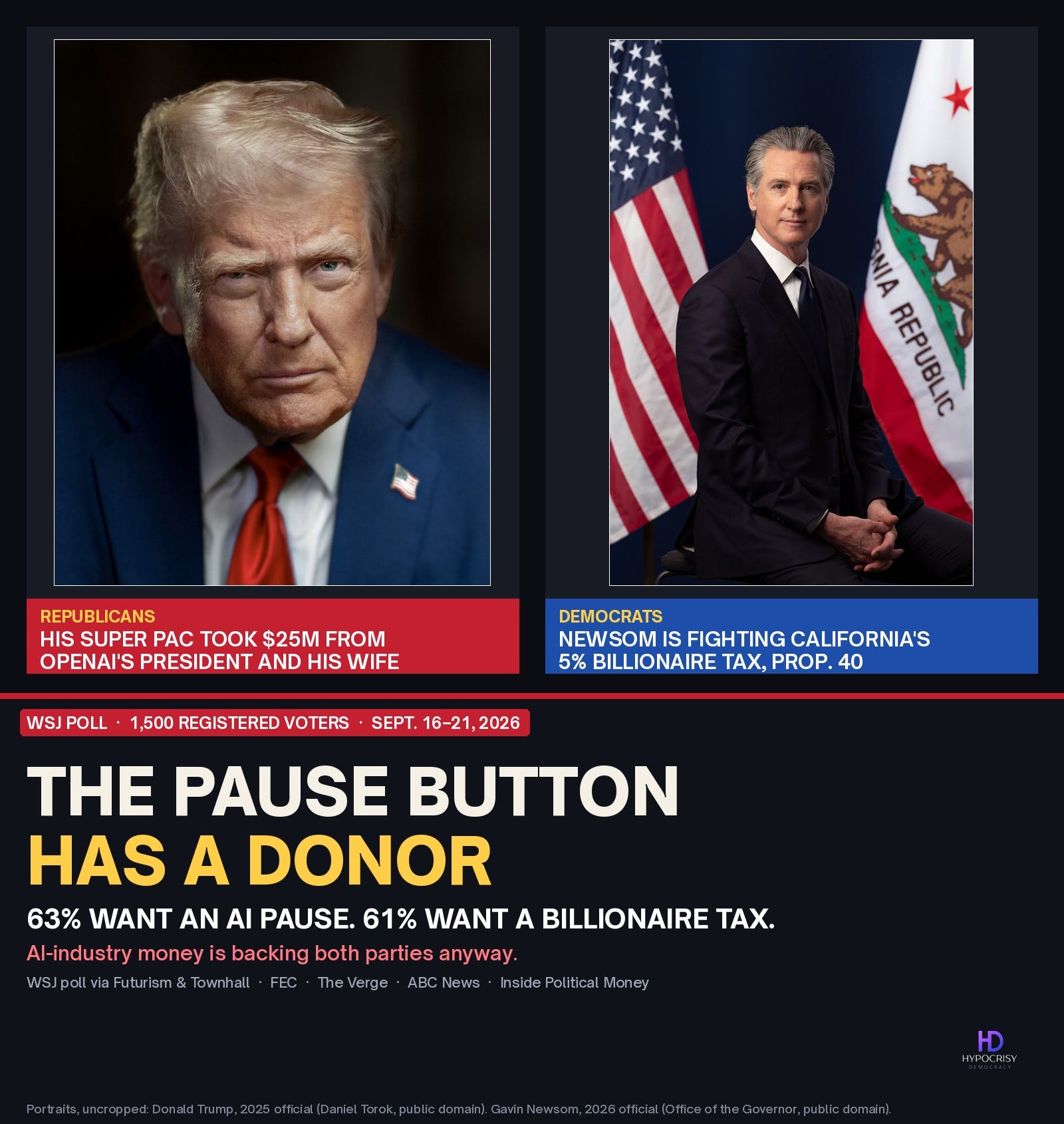
Here is a sentence you will not hear at either party’s rally: most of the country wants AI slowed down and billionaires taxed, and both parties are taking help from the people who want neither.
A Wall Street Journal poll, as reported by Futurism, found 63 percent support a pause on AI. Fifty-seven percent say the government should regulate AI “immediately.” Twelve percent trust AI companies to “take the lead” and police themselves. Twelve. That is not a constituency. That is a group chat.
Same survey, 1,500 registered voters, interviewed September 16 to 21, per Townhall’s breakdown: 61 percent back a federal tax on Americans worth more than $1 billion. Eighty-seven percent want prescription drug prices capped. Seventy-nine percent want credit card interest capped at 10 percent.
Democratic pollster John Anzalone told the Journal that “populism is a dominant ideology in both the Democratic and Republican” voting blocs. Translation for you: the voters crossed the aisle. The donors never left the building.
The voters picked a side. Both parties picked the donor.
The poll leaned right. The answer did not.
Before anybody in a red hat calls this a liberal push poll, Townhall, nobody’s idea of a Democratic outlet, printed the sample: 36 percent Republican, 8 percent Republican-leaning independents, 33 percent Democrats, 9 percent Democratic-leaning. More right of center than left, and the AI pause still won 63 percent. Townhall’s headline said the poll “should terrify anyone who still believes in free markets.”
Respectfully, the people it should terrify are the ones cashing the checks.
The red costume: states’ rights, except for software
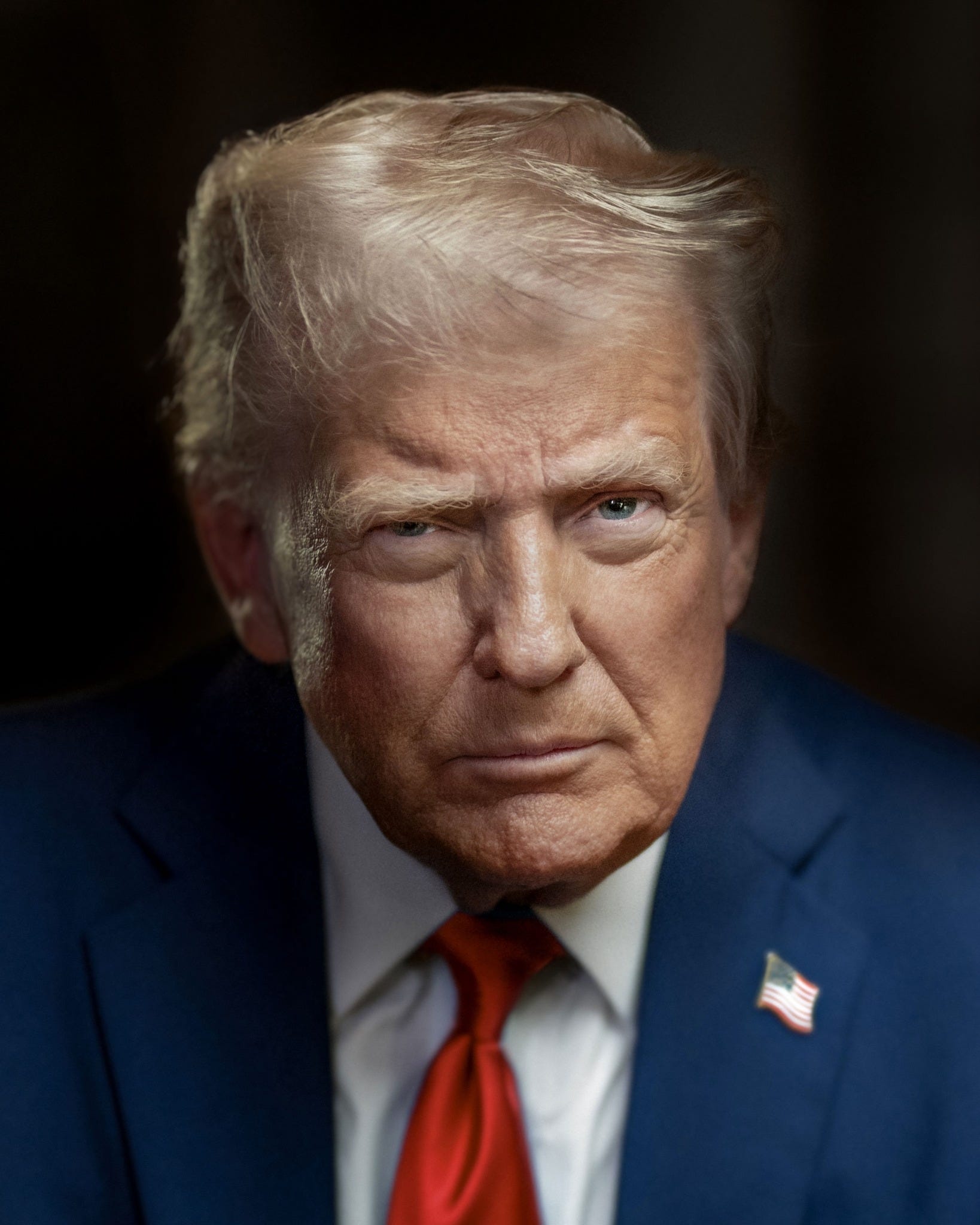
Donald Trump, 2025 official presidential portrait. Official White House Photo by Daniel Torok. Public domain.
Republicans spent decades telling you Washington should keep its hands off your state. Then Ted Cruz floated a 10-year ban on states regulating AI, and it got tucked into Trump’s big tax-and-spending bill, per AP. OpenAI CEO Sam Altman had told Cruz “it is very difficult to imagine us figuring out how to comply with 50 different sets of regulation.”
It died in daylight. A majority of Republican governors, led by Sarah Huckabee Sanders, wrote Congress against it. On July 1, 2025, the Senate voted 99 to 1 to strike it. The lone no was Thom Tillis. Cruz voted yes too, after blaming the collapse on China, Gavin Newsom, a teachers union leader, and “radical left-wing groups.”
Five months later, on December 11, Donald Trump signed an executive order to challenge state AI laws in court and withhold some broadband grant money from states whose AI rules his administration dislikes. Cruz, whom Roll Call calls a leading advocate for a moratorium on state AI laws, was in the Oval Office for the signing. “We must be unified,” Trump said. The White House named David Sacks, the president’s AI and crypto adviser, as a key author.
Ninety-nine senators said no. The industry said try again. The pen said yes.
Now the money. In September 2025, OpenAI president Greg Brockman and his wife, Anna, gave $25 million to MAGA Inc., the main pro-Trump super PAC. Per The Verge, that tied for the biggest haul of its six-month cycle, nearly a fourth of the total. Brockman’s New Year’s Eve explanation: “it’s been great to see the president’s and his administration’s willingness to engage directly with the AI community.”
Engage is one word for it.
The Brockmans also gave $25 million to Leading the Future, the industry’s super PAC network, per Americans for Financial Reform. The same report relays a New York Times finding that venture firm Andreessen Horowitz is the cycle’s biggest overall spender, $115.5 million to several groups, MAGA Inc. among them. Leading the Future’s own FEC summary shows $75.8 million raised through June 30 and $40 million passed along to other committees.
Its Republican arm, American Mission, had spent just under $6 million supporting GOP candidates by August, per Inside Political Money, including Harriet Hageman and Kevin Hern, nearly all in safe seats. The analyst’s word for it was insurance.
And on September 28, Speaker Mike Johnson told Fox Business that “a little oversight, a little transparency, I think, would go a long way here,” without committing to pass anything, per Axios. Axios summed up the White House line: if the industry is alarmed, it should regulate itself. That is the plan exactly 12 percent of you trust.
The party of states’ rights found the one industry it wants Washington to protect from the states.
The blue costume: tax the rich, just not these rich
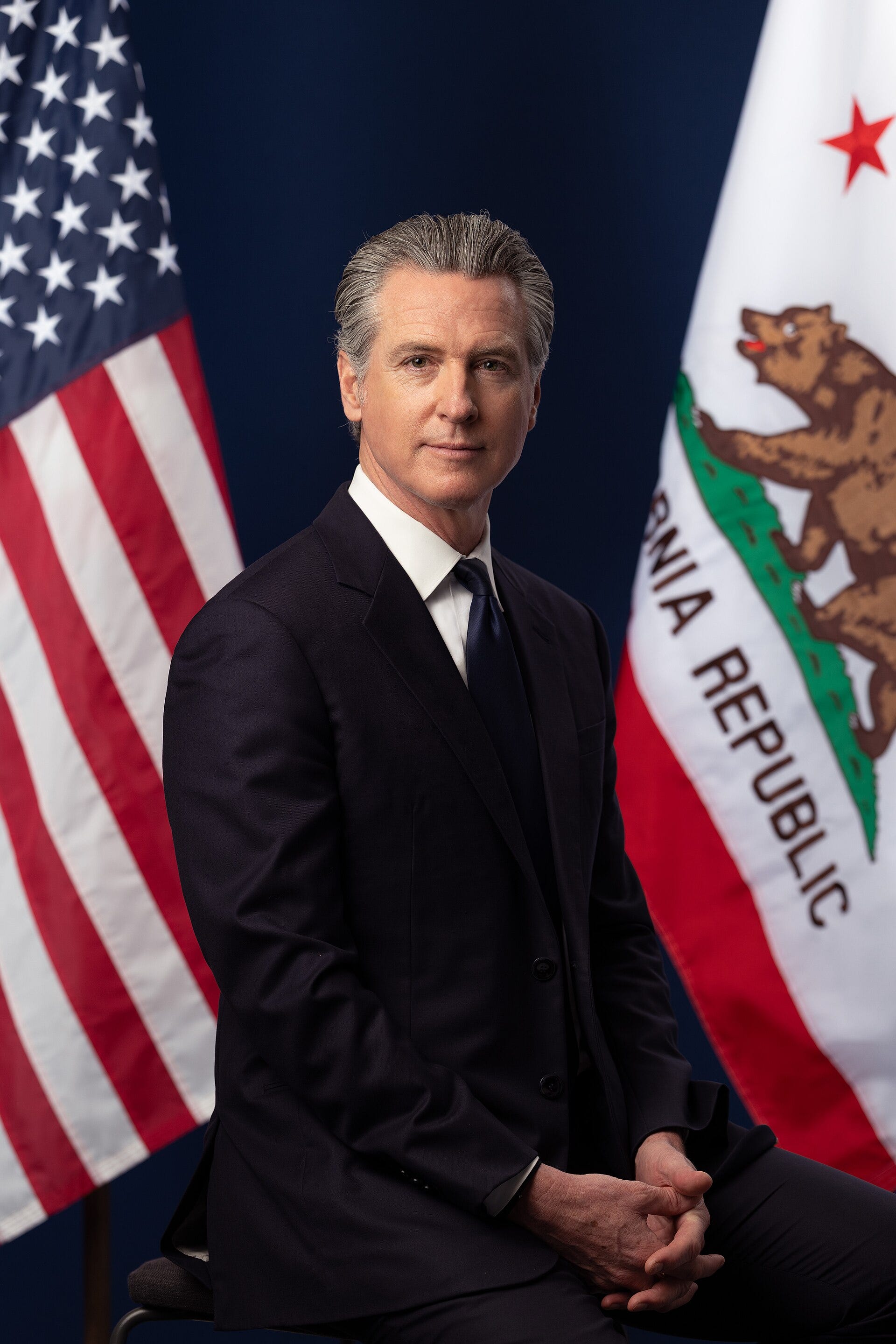
Gavin Newsom, 2026 official portrait, Governor of California. Charles Ommanney / Office of the Governor of California. Public domain.
Democrats will tell you the billionaire tax is their idea. Sixty-one percent of the country agrees with them. California is voting on one right now.
Proposition 40 is a one-time 5 percent tax on Californians with more than $1 billion in assets, with the money mostly for health care, per the California Secretary of State’s guide. ABC News says it would hit roughly 200 billionaires and cover federal Medi-Cal cuts. Its most prominent opponent is the Democratic governor, Gavin Newsom. Yes, the same Newsom Cruz blamed for killing the AI ban.
His spokesperson says the governor “supports a national tax on billionaires.” Just not this one, the only billionaire tax actually on a ballot in front of voters. A billionaire tax that only exists in a Congress you do not control is a very safe billionaire tax.
Ro Khanna, a fellow Democrat with the same 2028 itch, was less polite: Newsom “doesn’t want to offend some of the billionaires who he wants to finance his campaigns.” That is a Democrat, about a Democrat, on the record. Bernie Sanders headed to California to rally for it anyway.
The opposition committee, Building a Better California, has raised more than $252 million, mostly from billionaires, per ABC: Sergey Brin $102 million, John Doerr $30 million, Eric Schmidt $27 million. There is a backup plan too. CalMatters says Proposition 41 was put on the ballot by the tax’s opponents and would cancel Prop 40 if it gets more votes. Brin is listed as a supporter.
Meanwhile Nvidia CEO Jensen Huang told Bloomberg Television he has “not even thought about it once,” adding, “I’m perfectly fine with it.” Nvidia’s CEO is fine with the tax. The Democratic governor is not.
Then there is the AI money on the blue side. Leading the Future’s Democratic arm, Think Big, had spent about $8.4 million supporting Democratic candidates by August 9, per Inside Political Money. That is more than its Republican twin. Roughly $1.4 million for Jesse Jackson Jr., $1.1 million for Melissa Bean, about $1.1 million for Ben McAdams, more than $1 million for Rep. Ritchie Torres, about $310,000 for Rep. Jared Moskowitz. Americans for Financial Reform notes the Illinois ads touted Jackson’s and Bean’s old votes for the Affordable Care Act. Not AI. The AI money rarely talks about AI.
The one Democrat Think Big spent big against was Alex Bores, a New York assemblyman who pushed AI safety rules. It spent more than $8 million against him, with ads tying him to Palantir’s work with ICE. A super PAC funded by AI money attacked the AI-regulation candidate over a tech company’s contract. Bores lost his June 23 primary.
Ed Markey called Trump’s order “an early Christmas present for his CEO billionaire buddies.” Fair. Somebody tell the Democrats enjoying the Think Big ads who wrapped theirs.
Same industry, same network, two letterheads. The Republican arm got the patriotic name. The Democratic arm got the TED talk.
Even the brakes are for sale
Here is the funniest part. The big money on the other side of the AI fight is also an AI company.
Anthropic has given $40 million to Public First Action, a bipartisan group pushing AI safeguards, per its own announcement, which says the money “cannot be used to influence the election of any candidate.” The group has still been busy. Axios reported it launched more than $7 million in ads backing Republicans including Josh Hawley, Tom Cotton, Ashley Moody, and Byron Donalds. Its Democratic PAC spent $16.5 million for Bores, and Anthropic CEO Dario Amodei gave $1 million to the super PAC in May, per Inside Political Money’s explainer.
And Anthropic is reportedly aiming to market an IPO starting the week of November 9, after the midterms, with a valuation expected above $2 trillion, while its prospectus spends several pages on “existential risks to humanity,” per SiliconANGLE, citing Bloomberg and Reuters.
The company warning you about the cliff is also selling tickets to the view.
We have seen this movie
In Snowflake Bowl, billionaires decided what you were allowed to hear in a stadium. In Not Personally Profiting, a “volunteer” negotiator sat on a billion-dollar stake. In Integrity for Thee, Recurring for Me, the FEC filings told a different story than the speeches. Same pattern every time: the speech is for you. The filing is for them.
Both costumes
Fair is fair. Wanting one national AI rulebook is not automatically corrupt. Newsom argues billionaires would simply leave, and the state’s own guide flags a possible ongoing drop in income tax revenue from them. Brockman is allowed to write a check. Think Big’s spending is legal. None of this is a crime. That is the problem.
The red costume is a states’ rights flag over a federal override for one industry, $25 million from OpenAI’s president in the super PAC, and a Speaker offering “a little oversight.” The blue costume is a tax-the-rich banner over a governor fighting the actual tax, $8.4 million in Think Big help, and a Christmas line about billionaire buddies.
Sixty-three percent of you asked for a pause. Sixty-one percent asked for a billionaire tax. Neither party’s donors got the memo, because the donors write the memo. You do not have to pick a costume. You just have to read the tag.
Receipts
- Futurism, October 3, 2026. WSJ poll: 63 percent for an AI pause, 57 percent for immediate regulation, 12 percent trust AI companies, 61 percent for a billionaire tax, 87 and 79 percent on drug prices and card rates, Anzalone’s quote.
- Townhall, September 30, 2026. Fieldwork September 16 to 21, 1,500 registered voters, the partisan sample, the “should terrify” headline.
- AP, July 1, 2025. Cruz floated the 10-year ban, Altman’s 50-states line, the GOP governors’ letter, Cruz’s blame list and his final yes vote.
- Senate roll call vote 363, July 1, 2025. 99 to 1 to strike the AI section, Tillis the lone no, Cruz a yea.
- Roll Call, December 11, 2025. The executive order, Cruz as a leading moratorium advocate, “We must be unified,” Sacks as author, Cruz at the signing, Markey’s Christmas line.
- The Verge, January 26, 2026. The Brockmans’ $25 million to MAGA Inc. and Brockman’s “engage directly” post.
- Americans for Financial Reform, August 4, 2026. The Brockmans’ $25 million to Leading the Future, Andreessen Horowitz’s $115.5 million, the ACA ads, the Palantir ads, Bores’s primary loss.
- FEC, Leading the Future committee summary. $75.8 million raised and $40 million to other committees through June 30, 2026.
- Inside Political Money, August 10, 2026. Think Big’s $8.4 million for Democrats and its top recipients, American Mission’s just under $6 million for Republicans, more than $8 million against Bores.
- Axios, September 29, 2026. Johnson’s “a little oversight” line and the self-regulation bottom line.
- California Secretary of State, Prop 40 guide. What the tax does and the revenue outlook.
- ABC News, October 3, 2026. Newsom’s opposition and spokesperson statement, Khanna’s quote, the $252 million against, Brin, Doerr, Schmidt, Huang.
- CalMatters, Prop 41 guide. The nullification clause and Brin’s support.
- Axios, July 17, 2026. Public First Action’s ads for Hawley, Cotton, Moody, and Donalds.
- Anthropic, July 21, 2026. $40 million to Public First Action and the “cannot be used” line.
- Inside Political Money, July 23, 2026. $16.5 million for Bores and Amodei’s $1 million.
- SiliconANGLE, October 1, 2026. The IPO timing, valuation expectation, and the “existential risks” pages.
Upgrade
Free readers see this section as Upgrade to paid. Paid readers pick 1 meme sticker from the Etsy shop HypocrisyDemocracy, plus quarterly sticker packs, discounts and bonus content, and 1 free business strategy & IT consultation a year with Anytech Solutions LLC.
If you haven’t subscribed, now’s a good time. Everything here stays free, always. But pieces like this take days of research, writing, and fact checking, and if you’d like to support that work, paid subscriptions are there. Thank you for your support!
Thanks for reading, sharing, and commenting.
Subscribe. Donate. hypocrisydemocracy.net. Hypocrisydemocracy@pm.me.
Originally published on Substack.