
Use your majority

Here is the Senate Majority Leader on what happens if a Supreme Court seat opens up this year: “We would proceed quickly with such a vacancy.”
That was John Thune, per POLITICO. Sen. Thom Tillis went further: “You’ve got to use your majority position to take that vote.”
Here is the Senate Democratic leader, Chuck Schumer, on why you should give him the Senate: to “not let Trump put such horrible justices, MAGA justices, on the Supreme Court and the lower courts.”
One party wants to fill a seat that is not empty. The other wants to block a nominee who does not exist. And both have a speech on file arguing the opposite.
The vacancy nobody has
Let’s be clear about what is happening. No justice has announced anything. Per POLITICO, Justice Samuel Alito, 76, told Bloomberg News he would “stick around” at least until the current term ends early next summer. Justice Clarence Thomas, 78, has not publicly addressed retirement in years.
Thune himself doubts it: if a justice planned to retire, “They would have done it already.” Tillis: “I can’t think of anything other than health.”
But Republicans are privately ready anyway. If the GOP loses the Senate on November 3, POLITICO reports, both men would face “a mountain of pressure” to consider stepping down, so a Republican Senate could confirm a replacement in the lame duck. That would give Republicans just five scheduled session weeks. And a post-election retirement would be the first in the lame duck after a midterm since Mahlon Pitney in 1922, per the Congressional Research Service.
Translation: if you vote one way in November, they would like the outgoing Senate to make the decision anyway.
We wrote about Republicans planning for a loss they will not admit in public in The retreat is already staffed. This is the judicial wing of the same retreat.
Let the people decide (offer expired)
You remember 2016. Justice Antonin Scalia died in February. That night, Senate Majority Leader Mitch McConnell said, per PolitiFact: “The American people should have a voice in the selection of their next Supreme Court Justice. Therefore, this vacancy should not be filled until we have a new president.” He later added a hashtag: #LetThePeopleDecide.
Barack Obama’s nominee, Merrick Garland, never got a vote. Scalia’s seat opened 268 days before Election Day.

Merrick Garland in 2016, when Obama nominated him to the Supreme Court. The Senate never held a vote. Credit: U.S. Court of Appeals for the D.C. Circuit, public domain.
The late Sen. Lindsey Graham, then on the Judiciary Committee, said in March 2016 that if a Republican president faced a vacancy in the last year of a first term, “let’s let the next president, whoever it might be, make that nomination. And you could use my words against me, and you’d be absolutely right,” per PolitiFact. He repeated it in 2018.
Then Ruth Bader Ginsburg died in September 2020, 46 days before the election. Amy Coney Barrett was confirmed 38 days later, per POLITICO. McConnell’s new rationale: since the 1880s, no Senate had confirmed “an opposite-party president’s Supreme Court nominee in a presidential election year.”

Justice Amy Coney Barrett, official portrait. She was confirmed 38 days after Justice Ginsburg’s death in 2020. Credit: Supreme Court of the United States, public domain.
PolitiFact rated McConnell’s switch a “Full Flop.” Political scientist John J. Pitney Jr. gave the best summary anyone has managed: “Principle, schminciple — it’s all about power.”
The red costume: the rule is whoever holds the gavel
If you are a conservative who believes in restraint and tradition, this section is for you.
The 2016 rule was that the people should decide. The 2020 rule was that the people had already decided, back in 2016 and 2018. The 2026 rule, apparently, is that if the people decide the wrong way on November 3, the lame duck should decide before January.
Rutgers historian David Greenberg told PolitiFact that the McConnell standard boils down to “We control the Senate and will do what we wish.” That is not a principle. That is a parking spot.
Sen. Susan Collins, on the ballot this year, at least has a consistent sentence: “as long as it’s not close to a presidential election that we should proceed to consider nominees.” She cited it to vote against Barrett in 2020. Her rule covers presidential years only, which is why Democrats are hammering her instead for voting to confirm Brett Kavanaugh a month before the 2018 midterms, per POLITICO. Her Democratic opponent, Troy Jackson, says she “cannot be trusted with voting on our next Supreme Court Justice.” (We covered that race in The $1,500 tank.)
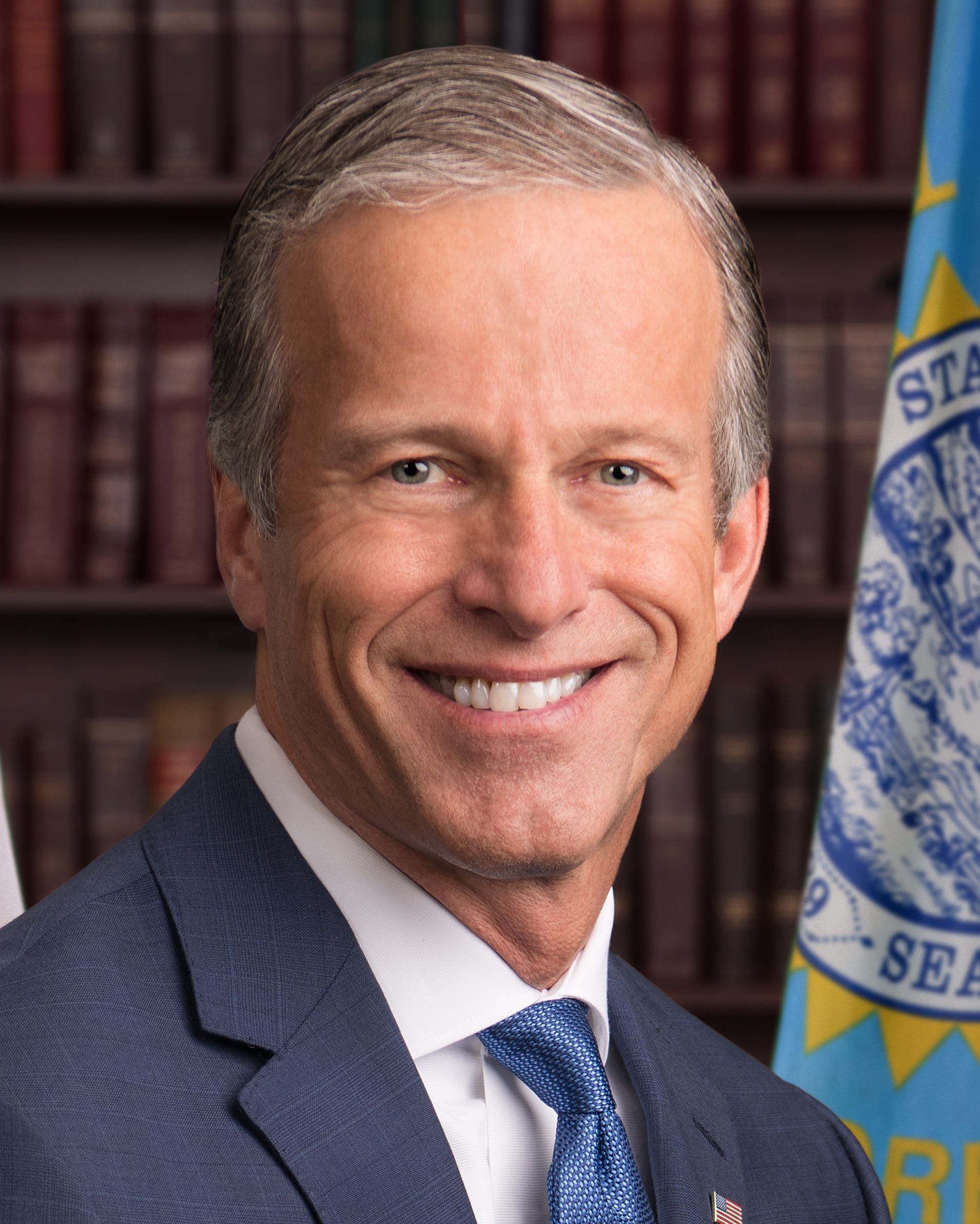
Senate Majority Leader John Thune, official portrait. On a lame-duck vacancy: “We would proceed quickly.” Credit: U.S. Senate Photographic Studio, public domain.
The blue costume: obstruction is bad, unless it is ours
Democrats, before you clap.
In July 2007, with President George W. Bush still in office for another 18 months, Schumer told the American Constitution Society, per his own Senate press release: “I will recommend to my colleagues that we should not confirm a Supreme Court nominee EXCEPT in extraordinary circumstances.” Capital letters his office’s.
In February 2016, the day after McConnell’s statement, the same Schumer called his stance “obstructionism,” per CNSNews. “This kind of obstructionism isn’t going to last,” he said. In 2026, his recruiting pitch is “two words that make a huge difference: Supreme Court,” and the promise is to block “MAGA justices.”
Then there is the original. On June 25, 1992, Senate Judiciary Chairman Joe Biden said that if a justice resigned that year, President Bush “should consider following the practice of a majority of his predecessors and not — and not — name a nominee until after the November election is completed,” per PolitiFact. There was no vacancy. McConnell later called it the “Biden Rule.”
In 2016, Democrats argued the seat should be filled right away, per PolitiFact. In September 2020, Biden said, per The American Presidency Project: “The voters should pick a President, and that President should select a successor to Justice Ginsburg.” He was citing the Republican position from 2016, a close cousin of his own from 1992.
His closing line that night: “That institution should not be subject to politics.” Every senator in both parties would agree, right up until it is their turn.
The machine both parties built
“Use your majority” did not start this year. Per PolitiFact, Democratic leader Harry Reid went first in 2013, letting circuit court judges through with a simple majority instead of 60 votes. Republicans returned the favor in 2017 to put Neil Gorsuch on the Court. Kavanaugh got there 50 to 48.
And in 2020, as McConnell moved on Barrett, Schumer quoted McConnell’s own 2016 line back at him, verbatim, in a tweet: “Americans should have a voice,” per PolitiFact. Every one of them is right about the other guy. That is the problem.
Both costumes
To be fair, timing does differ. Biden’s 1992 speech came with no vacancy at all. Ginsburg died 46 days out; Scalia, 268. A lame-duck confirmation after a midterm is not the same thing as a presidential-year fight. You can draw real lines here.
But neither party draws them before it knows who holds the gavel. Republicans said the people should decide, then decided the people had decided, and now want an outgoing Senate ready in case the people decide wrong. Democrats said obstruction was an outrage, after promising obstruction in 2007, and now campaign on promising it again.
Sen. Sheldon Whitehouse, expected to lead Judiciary Democrats next year, called it “not a hypothetical I’m ready to talk about.” Sen. Lisa Murkowski offered the most honest reaction in Washington: “Oh, gosh. You’re giving me the chills.”
You do not need a costume for this one. Write down what your senator says about Supreme Court timing now. Then save it for the day the gavel changes hands.
Receipts
- POLITICO via Yahoo News, October 7, 2026. Thune, Tillis, Collins, Whitehouse, and Murkowski quotes, Schumer’s pitch, the ages of Thomas and Alito, Alito’s “stick around,” the five session weeks, the Pitney precedent, Barrett’s 38 days, and Jackson’s line.
- PolitiFact, September 22, 2020. McConnell’s 2016 statement and 2020 rationale, 268 vs. 46 days, the “Full Flop,” and the Pitney and Greenberg quotes.
- PolitiFact, September 21, 2020. Graham’s 2016 “use my words against me” and his 2018 repeat.
- PolitiFact, March 17, 2016. Biden’s June 25, 1992 floor speech in context.
- Schumer Senate press release, July 31, 2007. The “EXCEPT in extraordinary circumstances” speech text.
- CNSNews, February 14, 2016. Schumer calling McConnell’s 2016 stance “obstructionism” on ABC’s This Week.
- The American Presidency Project, September 18, 2020. Biden’s statement on Ginsburg’s successor.
- Hypocrisy Democracy, The retreat is already staffed and The $1,500 tank. House GOP’s private expectations and the Collins-Jackson race.
Upgrade
Free readers see this section as Upgrade to paid. Paid readers pick 1 meme sticker from the Etsy shop HypocrisyDemocracy, plus quarterly sticker packs, discounts and bonus content, and 1 free business strategy & IT consultation a year with Anytech Solutions LLC.
If you haven’t subscribed, now’s a good time. Everything here stays free, always. But pieces like this take days of research, writing, and fact checking, and if you’d like to support that work, paid subscriptions are there. Thank you for your support!
Thanks for reading, sharing, and commenting.
Subscribe. Donate. hypocrisydemocracy.net. Hypocrisydemocracy@pm.me.
Originally published on Substack.