MORE THAN THE PENTAGON
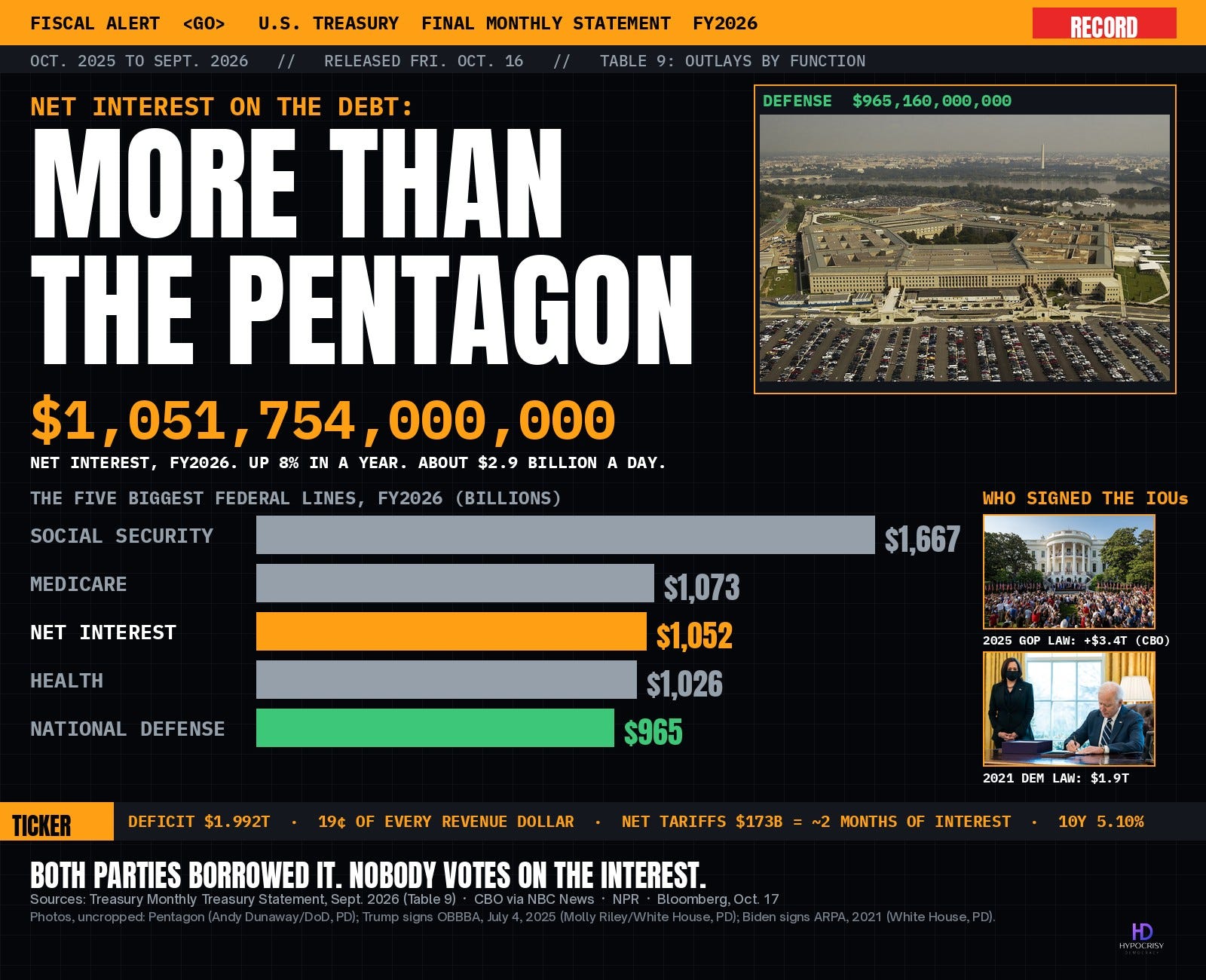
Quick question for you. What’s the biggest check Washington writes that nobody runs a campaign ad about? Take the white pill with me this morning. It’s the one that reads the receipt.
The bill came Friday
On Friday, the Treasury Department published its final Monthly Treasury Statement for fiscal year 2026, which ran from October 2025 through September. Here’s the line that should be on every debate stage: net interest on the debt, $1.052 trillion. That’s up from $970 billion the year before, about 8%.
For scale, using Treasury’s own table:
- National defense: $965 billion. Interest beat it by $87 billion.
- Medicare: $1.073 trillion. Interest is $21 billion behind.
- Share of all federal spending: about 14 cents of every dollar.
- Share of everything Washington collected: about 19 cents of every dollar of revenue.
- Per day: roughly $2.9 billion.
- Rank: third-biggest line in the budget by function, behind only Social Security and Medicare.
The full-year deficit was $1.992 trillion. Bloomberg called the interest bill a record high and reported that the Peter G. Peterson Foundation expects interest to hit 3.2% of GDP, topping the previous record set in 1991. Our market board, updated Saturday, had the 10-year Treasury yield at 5.10%. That’s the number behind mortgage rates and behind Washington’s next interest bill.
MORE THAN THE PENTAGON: and not one member of Congress had to vote for it this year.
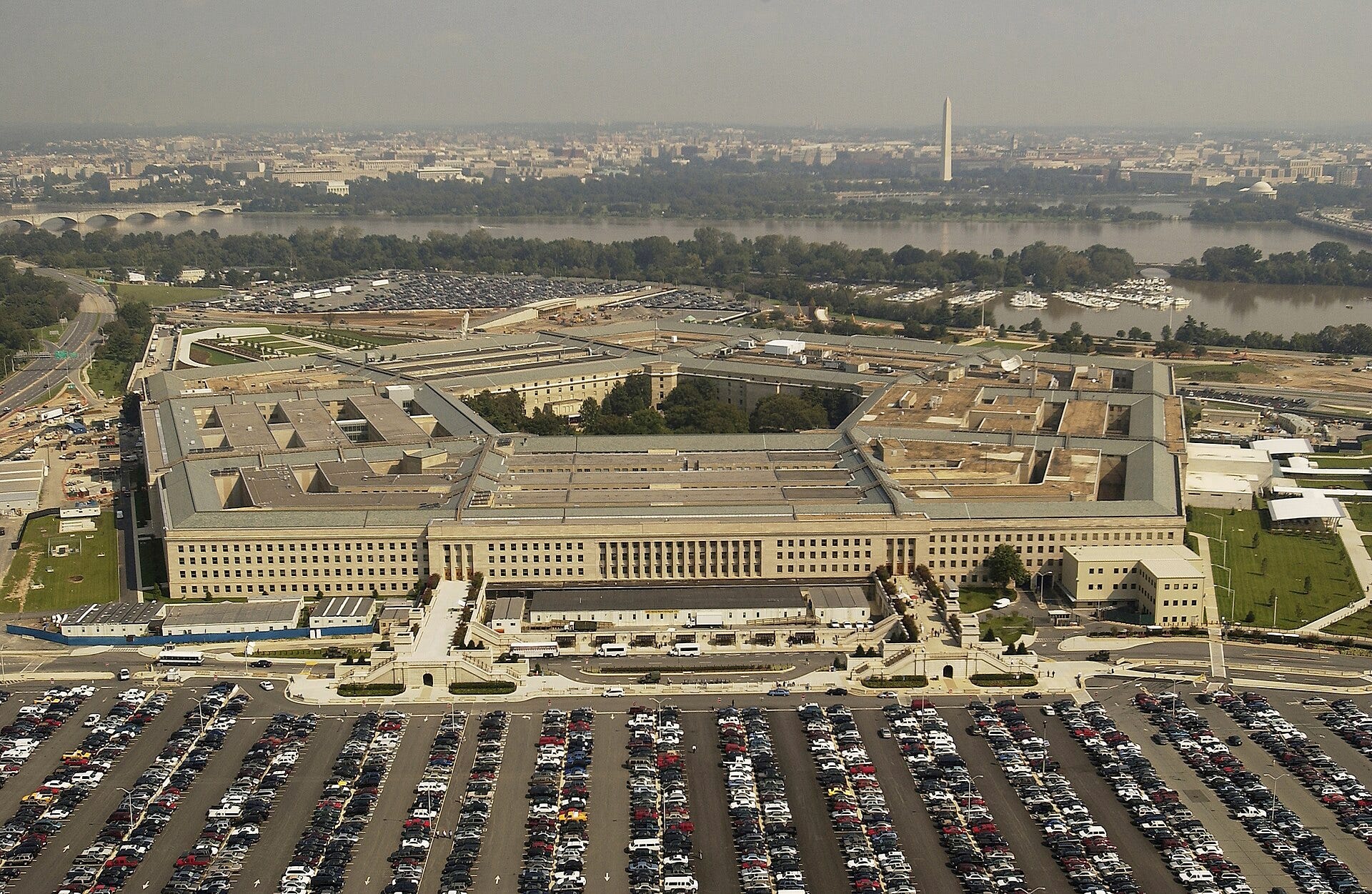
The Pentagon in Arlington, Virginia. In fiscal 2026, Washington spent $965 billion on national defense and $1.052 trillion on net interest, per Treasury's final Monthly Treasury Statement. Credit: Tech. Sgt. Andy Dunaway, U.S. Department of Defense, public domain via Wikimedia Commons.
The red costume: “pay down debt”
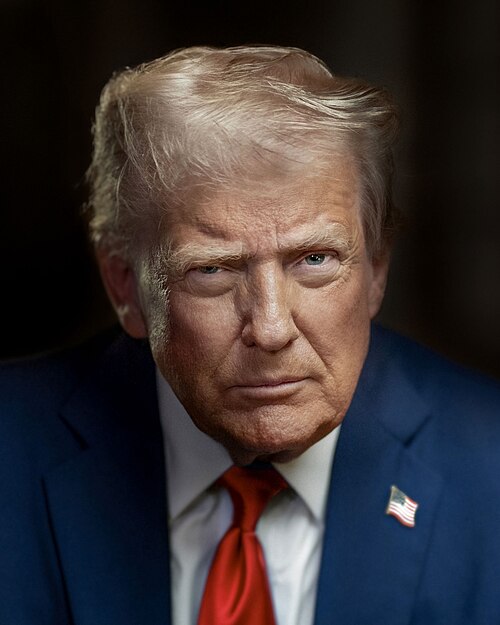
In March 2016, candidate Trump told The Washington Post he could eliminate the national debt “over a period of eight years.” In July 2025, talking about tariff money, he told reporters, “the big thing we want to do is pay down debt,” per CBS News.
The same month, he signed the One Big Beautiful Bill Act, which Republicans passed along party lines. The Congressional Budget Office projected it would add $3.4 trillion to the debt over a decade, NBC News reported.

President Trump signs the One Big Beautiful Bill Act on the South Lawn of the White House, July 4, 2025. The Congressional Budget Office projected the law would add $3.4 trillion to the debt over a decade. Credit: Molly Riley, The White House, public domain via Wikimedia Commons.
And the tariffs? Treasury’s table shows customs duties brought in $173 billion in fiscal 2026, net of refunds, down from $195 billion the year before. Corporate income tax receipts fell from $452 billion to $381 billion.
A year of tariff money covered about two months of interest.
The blue costume: deficits matter when the other guy signs
Democrats spent the summer of 2025 attacking the Republican law as a tax cut for the wealthy, per NBC. Fair enough. But in March 2021, they passed their own $1.9 trillion relief package without a single Republican vote, NPR reported. Different priorities, same credit card.
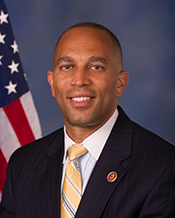
And the 2026 pitch adds to the tab. On Oct. 10 in Yardley, Pennsylvania, House Democratic Leader Hakeem Jeffries promised “a Democratic majority committed to reversing the painful Medicaid cuts,” per C-SPAN. Those cuts were part of how Republicans paid for some of their law, per NBC. Reversing them may be the right call. In that speech, he didn’t say how he’d pay for it.
Reversing a cut without a pay-for isn’t fiscal responsibility. It’s the same card with a different signature.
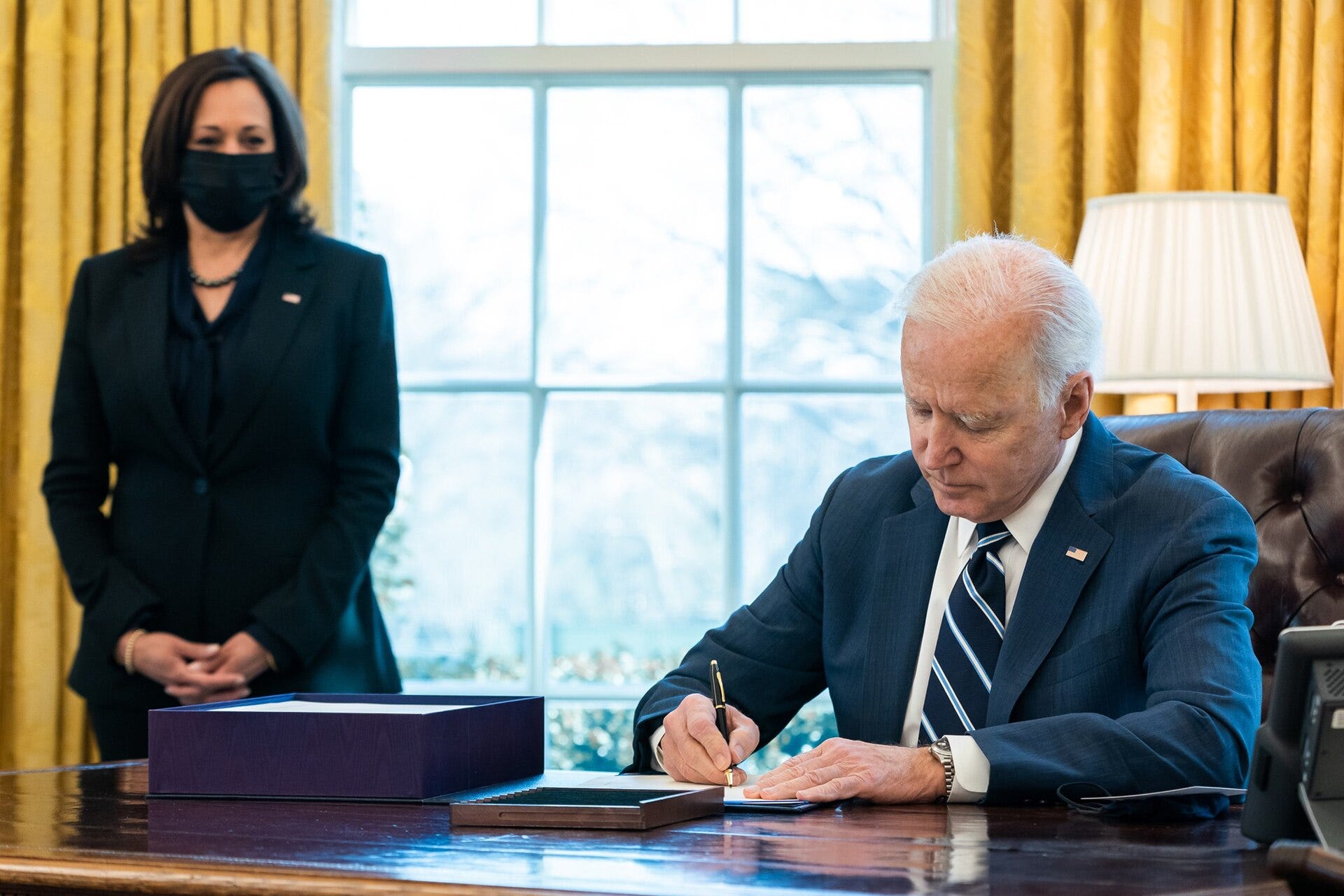
President Joe Biden signs the American Rescue Plan into law in the Oval Office, March 11, 2021. The $1.9 trillion package passed Congress without a single Republican vote. Credit: The White House, public domain via Wikimedia Commons.
Both costumes
Here’s the adult version.
Two of the decade’s biggest party-line laws each added trillions, and each party still calls the other one reckless. Interest doesn’t care whose name is on the bill. It compounds on all of it, and it’s now bigger than the military both parties say they’ll never shortchange.
The boring standard: every new tax cut and every new spending promise, from either party, gets a CBO score and a pay-for before it gets a press release.
Ask your candidates one question: what will you cut, or what will you raise, to pay for your top promise? If the answer is “growth” or “the other party,” you just heard the next interest payment. You can see where the campaign money behind those promises comes from on our Money Map and PACTracker.
Receipts
- U.S. Treasury, final Monthly Treasury Statement, fiscal year 2026. Table 9: net interest $1,051,754 million; national defense $965,160 million; Medicare $1,072,626 million; outlays $7.396 trillion; receipts $5.403 trillion; deficit $1.992 trillion; customs duties $173,219 million net; corporate income taxes $381,415 million.
- Bloomberg, Oct. 17, 2026. Record interest costs; Peterson Foundation 3.2% of GDP projection.
- The Washington Post, April 2, 2016. Trump: eliminate the debt “over a period of eight years.”
- CBS News, July 25, 2025. “The big thing we want to do is pay down debt.”
- NBC News, July 21, 2025. CBO: law adds $3.4 trillion; party-line passage; Medicaid and SNAP cuts as partial offsets.
- NPR, March 10, 2021. $1.9 trillion American Rescue Plan passes without Republican votes.
- C-SPAN, Oct. 10, 2026. Jeffries: “reversing the painful Medicaid cuts.”
- Earlier Hypocrisy Democracy: Deciding Mode; LOWER THAN BIDEN. Reader tools: market board; Money Map; PACTracker.
Upgrade
Free readers see this section as Upgrade to paid. Paid readers pick 1 meme sticker from the Etsy shop HypocrisyDemocracy, plus quarterly sticker packs, discounts and bonus content.
If you haven’t subscribed, now’s a good time. Everything here stays free, always. But pieces like this take days of research, writing, and fact checking, and if you’d like to support that work, paid subscriptions are there. Thank you for your support!
Thanks for reading, sharing, and commenting.
Subscribe. Donate. hypocrisydemocracy.net. Hypocrisydemocracy@pm.me.
Originally published on Substack.